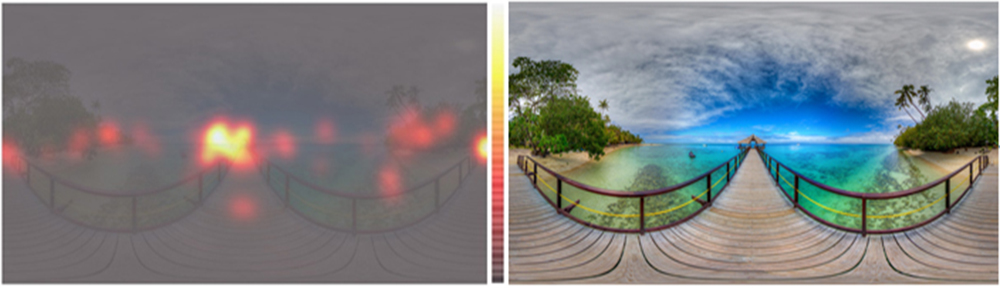
Overview:
Understanding visual attention has always been a topic of great interest in different research communities. This is particularly important in omnidirectional images (ODIs) viewed with a head-mounted display (HMD), where only a fraction of the captured scene is displayed at a time, namely viewport.
Here, we share a demo that displays a set of ODIs (provided by the user or using the ones available), while it collects the viewport’s center position at every animation frame for each ODI. The data collected is automatically downloaded at the end of the session.
https://www.scss.tcd.ie/~deabreua/visualAttentionVR/
Publications:
2017 |
Croci, Simone; Knorr, Sebastian; Smolic, Aljosa Saliency-Based Sharpness Mismatch Detection For Stereoscopic Omnidirectional Images Inproceedings Forthcoming 14th European Conference on Visual Media Production, London, UK, Forthcoming. @inproceedings{Croci2017a, title = {Saliency-Based Sharpness Mismatch Detection For Stereoscopic Omnidirectional Images}, author = {Simone Croci and Sebastian Knorr and Aljosa Smolic}, url = {https://v-sense.scss.tcd.ie/wp-content/uploads/2017/10/2017_CVMP_Saliency-Based-Sharpness-Mismatch-Detection-For-Stereoscopic-Omnidirectional-Images.pdf}, year = {2017}, date = {2017-12-11}, booktitle = {14th European Conference on Visual Media Production}, address = {London, UK}, abstract = {In this paper, we present a novel sharpness mismatch detection (SMD) approach for stereoscopic omnidirectional images (ODI) for quality control within the post-production work ow, which is the main contribution. In particular, we applied a state of the art SMD approach, which was originally developed for traditional HD images, and extended it to stereoscopic ODIs. A new e cient method for patch extraction from ODIs was developed based on the spherical Voronoi diagram of equidistant points evenly distributed on the sphere. The subdivision of the ODI into patches allows an accurate detection and localization of regions with sharpness mismatch. A second contribution of the paper is the integration of saliency into our SMD approach. In this context, we introduce a novel method for the estimation of saliency maps from viewport data of head-mounted displays (HMD). Finally, we demonstrate the performance of our SMD approach with data collected from a subjective test with 17 participants.}, keywords = {}, pubstate = {forthcoming}, tppubtype = {inproceedings} } In this paper, we present a novel sharpness mismatch detection (SMD) approach for stereoscopic omnidirectional images (ODI) for quality control within the post-production work ow, which is the main contribution. In particular, we applied a state of the art SMD approach, which was originally developed for traditional HD images, and extended it to stereoscopic ODIs. A new e cient method for patch extraction from ODIs was developed based on the spherical Voronoi diagram of equidistant points evenly distributed on the sphere. The subdivision of the ODI into patches allows an accurate detection and localization of regions with sharpness mismatch. A second contribution of the paper is the integration of saliency into our SMD approach. In this context, we introduce a novel method for the estimation of saliency maps from viewport data of head-mounted displays (HMD). Finally, we demonstrate the performance of our SMD approach with data collected from a subjective test with 17 participants. |
Croci, Simone; Knorr, Sebastian; Goldmann, Lutz; Smolic, Aljosa A Framework for Quality Control in Cinematic VR Based on Voronoi Patches and Saliency Inproceedings Forthcoming International Conference on 3D Immersion, Brussels, Belgium, Forthcoming. @inproceedings{Croci2017b, title = {A Framework for Quality Control in Cinematic VR Based on Voronoi Patches and Saliency}, author = {Simone Croci and Sebastian Knorr and Lutz Goldmann and Aljosa Smolic}, url = {https://v-sense.scss.tcd.ie/wp-content/uploads/2017/10/2017_IC3D_A-FRAMEWORK-FOR-QUALITY-CONTROL-IN-CINEMATIC-VR-BASED-ON-VORONOI-PATCHES-AND-SALIENCY.pdf}, year = {2017}, date = {2017-12-11}, booktitle = {International Conference on 3D Immersion}, address = {Brussels, Belgium}, abstract = {In this paper, we present a novel framework for quality control in cinematic VR (360-video) based on Voronoi patches and saliency which can be used in post-production workflows. Our approach first extracts patches in stereoscopic omnidirectional images (ODI) using the spherical Voronoi diagram. The subdivision of the ODI into patches allows an accurate detection and localization of regions with artifacts. Further, we introduce saliency in order to weight detected artifacts according to the visual attention of end-users. Then, we propose different artifact detection and analysis methods for sharpness mismatch detection (SMD), color mismatch detection (CMD) and disparity distribution analysis. In particular, we took two state of the art approaches for SMD and CMD, which were originally developed for conventional planar images, and extended them to stereoscopic ODIs. Finally, we evaluated the performance of our framework with a dataset of 18 ODIs for which saliency maps were obtained from a subjective test with 17 participants.}, keywords = {}, pubstate = {forthcoming}, tppubtype = {inproceedings} } In this paper, we present a novel framework for quality control in cinematic VR (360-video) based on Voronoi patches and saliency which can be used in post-production workflows. Our approach first extracts patches in stereoscopic omnidirectional images (ODI) using the spherical Voronoi diagram. The subdivision of the ODI into patches allows an accurate detection and localization of regions with artifacts. Further, we introduce saliency in order to weight detected artifacts according to the visual attention of end-users. Then, we propose different artifact detection and analysis methods for sharpness mismatch detection (SMD), color mismatch detection (CMD) and disparity distribution analysis. In particular, we took two state of the art approaches for SMD and CMD, which were originally developed for conventional planar images, and extended them to stereoscopic ODIs. Finally, we evaluated the performance of our framework with a dataset of 18 ODIs for which saliency maps were obtained from a subjective test with 17 participants. |
Monroy, Rafael; Lutz, Sebastian; Chalasani, Tejo; Smolic, Aljosa SalNet360: Saliency Maps for omni-directional images with CNN Unpublished 2017. @unpublished{Monroy2017, title = {SalNet360: Saliency Maps for omni-directional images with CNN}, author = {Rafael Monroy and Sebastian Lutz and Tejo Chalasani and Aljosa Smolic}, url = {https://arxiv.org/abs/1709.06505}, year = {2017}, date = {2017-09-19}, abstract = {The prediction of Visual Attention data from any kind of media is of valuable use to content creators and used to efficiently drive encoding algorithms. With the current trend in the Virtual Reality (VR) field, adapting known techniques to this new kind of media is starting to gain momentum. In this paper, we present an architectural extension to any Convolutional Neural Network (CNN) to fine-tune traditional 2D saliency prediction to Omnidirectional Images (ODIs) in an end-to-end manner. We show that each step in the proposed pipeline works towards making the generated saliency map more accurate with respect to ground truth data. }, keywords = {}, pubstate = {published}, tppubtype = {unpublished} } The prediction of Visual Attention data from any kind of media is of valuable use to content creators and used to efficiently drive encoding algorithms. With the current trend in the Virtual Reality (VR) field, adapting known techniques to this new kind of media is starting to gain momentum. In this paper, we present an architectural extension to any Convolutional Neural Network (CNN) to fine-tune traditional 2D saliency prediction to Omnidirectional Images (ODIs) in an end-to-end manner. We show that each step in the proposed pipeline works towards making the generated saliency map more accurate with respect to ground truth data. |
Abreu, Ana De; Ozcinar, Cagri; Smolic, Aljosa Look around you: saliency maps for omnidirectional images in VR applictions Inproceedings 9th International Conference on Quality of Multimedia Experience (QoMEX), 2017. @inproceedings{AnaDeAbreuCagriOzcinar2017, title = {Look around you: saliency maps for omnidirectional images in VR applictions}, author = { Ana De Abreu and Cagri Ozcinar and Aljosa Smolic}, url = {https://www.researchgate.net/publication/317184829_Look_around_you_Saliency_maps_for_omnidirectional_images_in_VR_applications}, year = {2017}, date = {2017-05-31}, booktitle = {9th International Conference on Quality of Multimedia Experience (QoMEX)}, abstract = {Understanding visual attention has always been a topic of great interest in the graphics, image/video processing, robotics and human computer interaction communities. By understanding salient image regions, the compression, transmission and render- ing algorithms can be optimized. This is particularly important in omnidirectional images (ODIs) viewed with a head-mounted display (HMD), where only a fraction of the captured scene is displayed at a time, namely viewport. In order to predict salient image regions, saliency maps are estimated either by using an eye tracker to collect eye fixations during subjective tests or by using computational models of visual attention. However, eye tracking developments for ODIs are still in the early stages and although a large list of saliency models are available, no particular attention has been dedicated to ODIs. Therefore, in this paper, we consider the problem of estimating saliency maps for ODIs viewed with HMDs, when the use of an eye tracker device is not possible. We collected viewport data of 32 participants for 21 ODIs and propose a method to transform the gathered data into saliency maps. The obtained saliency maps are compared in terms of image exposition time used to display each ODI in the subjective tests. Then, motivated by the equator bias tendency in ODIs, we propose a post-processing method, namely FSM, to adapt current saliency models to ODIs requirements. We show that the use of FSM on current models improves their performance by up to 20%. The developed database and testbed are publicly available with this paper.}, keywords = {}, pubstate = {published}, tppubtype = {inproceedings} } Understanding visual attention has always been a topic of great interest in the graphics, image/video processing, robotics and human computer interaction communities. By understanding salient image regions, the compression, transmission and render- ing algorithms can be optimized. This is particularly important in omnidirectional images (ODIs) viewed with a head-mounted display (HMD), where only a fraction of the captured scene is displayed at a time, namely viewport. In order to predict salient image regions, saliency maps are estimated either by using an eye tracker to collect eye fixations during subjective tests or by using computational models of visual attention. However, eye tracking developments for ODIs are still in the early stages and although a large list of saliency models are available, no particular attention has been dedicated to ODIs. Therefore, in this paper, we consider the problem of estimating saliency maps for ODIs viewed with HMDs, when the use of an eye tracker device is not possible. We collected viewport data of 32 participants for 21 ODIs and propose a method to transform the gathered data into saliency maps. The obtained saliency maps are compared in terms of image exposition time used to display each ODI in the subjective tests. Then, motivated by the equator bias tendency in ODIs, we propose a post-processing method, namely FSM, to adapt current saliency models to ODIs requirements. We show that the use of FSM on current models improves their performance by up to 20%. The developed database and testbed are publicly available with this paper. |